Running a small business means making every investment count, including the benefits you offer your employees. While you may not have the budget for an extensive benefits programme, providing meaningful support can still make a significant difference to your team’s wellbeing, engagement, and long-term retention.
Employee benefits are no longer limited to medical insurance or annual leave. Many small businesses are introducing flexible work arrangements, wellness initiatives, learning opportunities, and lifestyle perks to create a better employee experience. The key is choosing benefits that your employees genuinely value while keeping costs manageable and administration simple.
Here’s the reassuring part: good benefits don’t have to mean big spending. Many of the most valued perks cost little and flex as your business grows. This guide covers what’s legally required in Singapore, which optional benefits deliver the most value, the common obstacles SMEs face, and practical ways to build a package that competes without straining your budget.
Why Employee Benefits Matter for Small Businesses
A thoughtful benefits package shapes how candidates see you, how long employees stay, and how engaged they are in the role.
Start with attraction. When a candidate weighs two similar salaries, benefits often tip the decision. A ten-person design studio offering flexible hours and a wellness allowance can out-compete a larger firm with a rigid nine-to-six culture.
Retention follows similar logic. Replacing an employee is costly, and for a small team, losing one person can disrupt an entire department. When people feel supported through leave, healthcare, or financial wellbeing programmes, they’re less likely to start looking elsewhere.
Benefits shape employee engagement too. A retail business that recognises staff milestones publicly, even with a shout-out and a small voucher, tends to see people show up with more energy.
There’s a brand dimension as well. Job seekers research employers before applying, and a business known for looking after its people builds a reputation that reduces future hiring costs. And in small teams where every contribution is visible, a supported workforce isn’t a nice-to-have. It’s operational resilience.
Mandatory vs Optional Employee Benefits
Before building anything new, separate what the law requires from what you choose to offer. Compliance keeps you out of trouble, but it won’t make you competitive on its own.
Mandatory Benefits
In Singapore, employers must provide several statutory benefits under the Employment Act and CPF Act. CPF contributions apply to all eligible employees, with rates varying by age and wage. Annual leave starts at seven days in year one, rising by a day each year up to fourteen. Paid sick leave runs up to fourteen days outpatient and sixty days if hospitalised, alongside eleven paid public holidays a year. Maternity leave is sixteen weeks for citizen children, and paternity leave is four weeks for children born from January 2025 onwards.
Also read: 13 Employee Benefits in Singapore: Compulsory & Beyond [2026]
These are legal baselines, not competitive advantages. Every employer offers them, so they won’t be what makes a candidate choose you.
Optional Benefits
This is where real differentiation happens. Optional benefits give small businesses the opportunity to tailor their offerings to what employees value most. Even simple, affordable initiatives can have a meaningful impact on engagement, wellbeing, and retention. The right package signals you understand your people, not just the law.
11 Employee Benefits Every Small Business Should Consider
These consistently deliver value for SMEs, ranked by how often they influence hiring and retention decisions.
1. Flexible working arrangements
Hybrid setups, remote options, and flexible hours cost little beyond initial policy adjustments, yet rank among the most requested benefits. Suits knowledge roles and businesses competing for talent that values autonomy.
2. Learning and development support
Providing employees with access to courses, certifications, or books demonstrates a commitment to their long-term career growth, not just their day-to-day performance. Even with a modest annual budget, small businesses can empower employees to choose learning opportunities that align with their roles and career aspirations. This benefit is particularly valuable for growing businesses that want to build skills internally rather than rely solely on external hiring.
3. Transport or commuting support
Parking subsidies, transport allowances, or fuel support matter most outside central transport hubs. Costs are predictable and easy to budget. Suits businesses where commute cost is a barrier to attracting talent.
4. Dental and optical allowance
Coverage for dental check-ups and vision costs beyond MediShield Life, giving employees essential coverage within your budget. They’re valued because these costs aren’t otherwise covered and add up over time. Costs far less than full medical plans. Suited to businesses wanting solid coverage without a large insurance spend.
5. Team experiences
Company outings, team lunches, and celebrations build connection that’s hard to manufacture through formal programmes. Costs are typically one-off and scale with team size. Matters most when rebuilding culture after growth or restructuring.
6. Recognition and rewards
Peer recognition, spot awards, and milestone rewards cost very little, sometimes just a small voucher, yet have an outsized effect on morale. Suits any team where visibility of effort matters, which for small businesses is almost always.
7. Flexible benefits allowance
Fixed benefits assume every employee wants the same thing, but a single parent, a fresh graduate, and someone nearing retirement have different priorities. A flexible allowance lets each person choose how to spend it, at whatever budget you set per head, with no wastage.
8. Gift vouchers
Gift vouchers for meals, treats, or retail discounts give employees a flexible reward with no guesswork over value. They cost only what you allocate per voucher and suit everyday appreciation or bigger milestones. Ideal for businesses wanting a simple, low-admin way to reward staff often.
9. Airline miles
Airline miles let employees convert part of their rewards into travel, appealing to frequent travellers and anyone saving toward a holiday. Costs align with however many miles you fund. Suits businesses with a well-travelled or aspirational workforce looking for a distinctive, memorable perk.
10. Wellness programmes
Covering mental health support, fitness subsidies, and health screenings, wellness programmes address a growing priority. Costs range from modest subscriptions to occasional screenings. Suits businesses with high-stress roles or younger workforces prioritising preventive care.
11. Lifestyle benefits
Dining, shopping, entertainment, and subscription perks are easy to administer through voucher or points-based systems, costing as much as you allocate. Suits younger, urban workforces who value everyday convenience.
Also read: Employee Perks: 35 Ideas & How to Personalise Them
Common Challenges Small Businesses Face
Even with the best intentions, small businesses run into recurring obstacles here. Budgets are limited, and every dollar spent on benefits could go elsewhere. Most SMEs lack a dedicated HR team, so administration falls on a founder already stretched thin.
Preferences are rarely uniform, either. A twenty-person team might span four generations with different priorities, making one-size-fits-all packages inefficient. Administration is often difficult without the right systems, relying on spreadsheets and reimbursement chasing, and the result is often low utilisation: benefits announced once, then forgotten.
How Small Businesses Can Offer Great Benefits Without Overspending
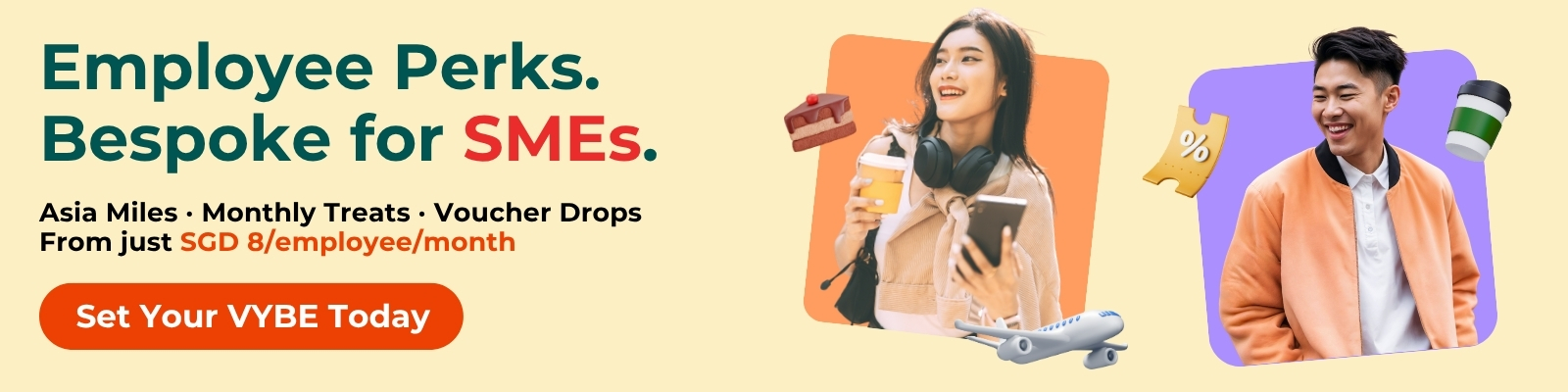
Offering personalised employee benefit doesn’t have to mean investing in an expensive benefits programme or adding more work for your HR team. VYBE is designed specifically for small business employee benefits to provide meaningful perks without the complexity, administration or high cost.
Give employees perks they’ll actually use
Instead of giving every employee the same voucher or benefit, VYBE lets employees choose rewards that match their own interests and lifestyle. Whether they’re saving for their next holiday, enjoying a coffee break or looking for everyday savings, employees can redeem rewards they’ll genuinely value.
Popular rewards include:
- Asia Miles to help fund future travel or redeem flights and experiences.
- Monthly Surprise Treats from popular cafés and bakeries.
- Friday Freebies featuring voucher drops from brands such as Grab, Giant, Klook, Swensen’s and Decathlon.
- Monthly Jackpot, where employees can win exciting prizes, including 10,000 Asia Miles.
Deliver value beyond one-off rewards
VYBE also gives employees access to a curated Discounts Marketplace featuring ongoing savings across travel, shopping, dining, wellness, lifestyle and e-commerce. This means employees continue receiving value throughout the year, rather than only during company celebrations or festive campaigns.
Affordable and easy to manage
Built with growing businesses in mind, VYBE removes much of the administration involved in running an employee perks programme. HR teams can manage everything from a single platform, while employees enjoy the flexibility to choose rewards they’ll actually appreciate.
With plans starting from the price of a kopi each month, VYBE makes personalised employee perks accessible to businesses of all sizes.
Ready to launch your employee benefits with VYBE?
If you’re looking for an affordable way to improve employee satisfaction without introducing a complex benefits programme, VYBE is a simple place to start.
Request a demo to see how VYBE can help launch your small business employee benefits people actually want.